
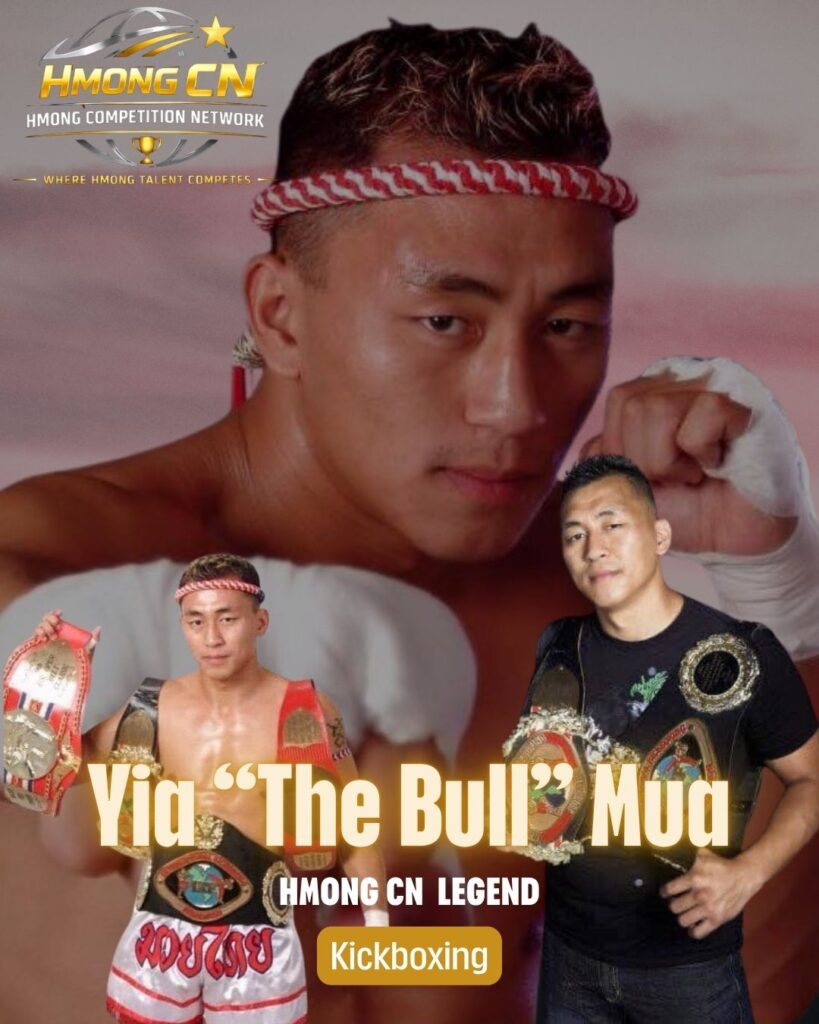
When people talk about legends, the conversation usually starts with stats, records, and titles, but that’s not what truly defines a Hmong legend. What matters most is impact. Yia “The Bull” Mua is one of those rare names that didn’t need numbers to be remembered. His name moved through the community long before many people ever saw him fight.
Before social media, before easy access to highlights, and before athletes had platforms, there was Hmong New Year, and during that time, his presence was undeniable. His posters were everywhere. Booths, walls, throughout the crowd, you couldn’t walk through without seeing his name. It wasn’t just promotion, it was recognition. Even without knowing his full story, people understood this was someone different. There was a presence to it, like the community had already claimed him as one of their own. And once people saw what he did in the ring, it only confirmed it.
Fighting out of Fresno, Yia built his reputation in Muay Thai with a style that lived up to “The Bull,” constant pressure, physical, relentless. He didn’t just win fights, he controlled them. But what truly separates Yia, and what places him firmly in the Hmong CN Legend category, goes beyond his fighting style. It’s about when he did it. He came up in a time when Hmong athletes had little to no visibility. There were no platforms pushing their stories, no easy ways to build recognition. A name only traveled if it meant something, if people talked about it, if it left an impression.
And Yia’s name traveled. He became someone the community respected, someone they were proud of, a fighter whose impact reached beyond the ring and into the culture itself. When he fought, it carried meaning not just for him, but for everyone watching. He showed that a Hmong fighter could step into a combat sport, compete at a high level, win, headline, and represent with pride. That kind of visibility helped shift what people believed was possible.
And that matters, because every generation builds on what came before it, and Yia helped lay that foundation. Even today, his name still comes up, not just for what he accomplished, but for the feeling tied to that era, the presence, the pride, the way the community stood behind him. That kind of legacy can’t be manufactured. Yia “The Bull” Mua wasn’t just a fighter, he was a moment, a symbol of representation before it was common, and one of the names that helped open the door.